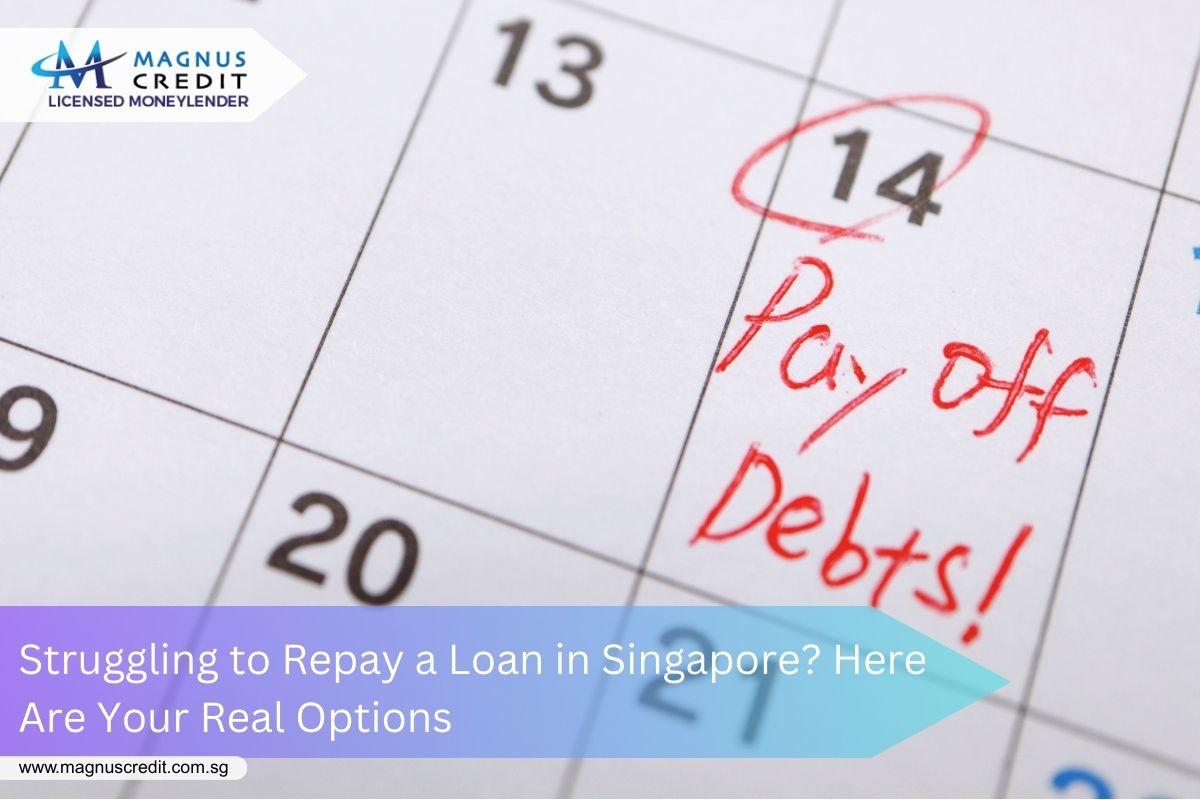
Most financial guides talk about borrowing. Far fewer talk about what to do when repayment becomes difficult — which is precisely when the relevant information matters the most.
If you are a Singapore borrower finding it hard to keep up with loan repayments, you are not without options. The path forward depends on your specific situation: whether you have one loan or several, whether you are dealing with a temporary cash flow gap or a longer-term income shortfall, and how early you act. This guide covers every realistic option available to you, in plain terms.
Key Takeaways
|
Why the Timing of Your Response Matters
The options available to a borrower in repayment difficulty changes depending on how far the situation has progressed. A borrower who contacts their lender before missing a payment has the most flexibility. A borrower who has already defaulted and stopped communicating has the fewest option.
This is not about blaming — financial difficulty can happen to anyone. It is simply a practical reality: lenders, courts, and debt management programmes all respond more favourably to borrowers who engage proactively.
If you are reading this before anything has been missed, the best thing you can do is act on one of the options below today.
Option 1: Direct Repayment Restructuring With Your Lender
The simplest and fastest option — and the one most borrowers overlook.
Licensed moneylenders in Singapore are permitted to restructure repayment terms on a case-by-case basis. This might mean extending the repayment period (which lowers your monthly instalment), temporarily reducing the payment amount, or working out a revised schedule that accounts for a change in your income.
This is not a formal programme. It is a direct conversation between you and your lender. There is no paperwork with external agencies, no public record, no waiting period.
When it works best: You have a single loan, a temporary income disruption (medical leave, job transition, unexpected expenses), and you approach your lender early.
What to bring to the conversation:
- Your current loan statement — outstanding principal, interest accrued, remaining installments
- A clear picture of what you can realistically pay monthly in your current situation
- A proposed revised schedule, even a rough one — lenders respond better to borrowers with a plan than to those asking for open-ended flexibility
At Magnus Credit Pte Ltd, we review restructuring requests individually. Contact us at +65 6338 9891 or visit our Ubi Office directly.
Option 2: Debt Consolidation
If the repayment difficulty you are facing comes from managing multiple loans at different rates across different lenders, consolidation is almost always the more practical solution.
A debt consolidation loan combines your existing debts into a single loan with one fixed monthly repayment. The advantages are straightforward:
- One payment, one due date. Eliminating multiple repayment schedules removes the administrative burden and the risk of missing one.
- Potentially lower interest cost. Depending on the rates on your existing loans, consolidation into a single loan at a lower rate can reduce the total amount you repay.
- Fixed repayment horizon. You know exactly when the debt ends, which makes budgeting manageable.
When it works best: You have two or more active loans, you are currently meeting repayments but finding it increasingly difficult, and your income is stable enough to support a consolidated monthly payment.
Important: Consolidation works as a forward-looking solution when approached before defaults occur. Once payments have been missed and the situation has escalated, eligibility for consolidation may be affected.
If you are considering this route, apply through our Singpass application or speak to our team directly about your current obligations.
Option 3: The Moneylender Debt Management Programme (MDMP)
The MDMP is a formal debt restructuring programme specifically for borrowers with unsecured debts owing to licensed moneylenders in Singapore. It is facilitated by Credit Counselling Singapore (CCS), a registered non-profit, and is distinct from the bank-focused Debt Consolidation Plan (DCP) or the bank-focused Debt Management Programme (DMP).
What the MDMP does: CCS acts as an intermediary between you and your licensed moneylender creditors. It assesses your income and total debt, then works out a restructured repayment arrangement that all participating lenders agree to.
Eligibility:
- You must have unsecured debts with licensed moneylenders
- CCS must assess that you have sufficient capacity to repay within two years
- If you have both bank debts and moneylender debts, you may need to qualify for both the DMP and MDMP simultaneously
Costs:
- Initial CCS information talks and counselling sessions are free
- If you proceed with the MDMP, there is a one-off administrative fee of SGD 50–250 depending on the size of your debt
What to expect:
- Your MDMP status is not publicly recorded, but it will be visible on your CBS report while the programme is active — and removed once it is completed
- While on the MDMP, you will typically be unable to take on new unsecured credit
- Repayment discipline during the programme rebuilds your repayment record on the MLCB
When it works best: You have multiple moneylender debts, repayment is genuinely unmanageable, and you need a structured arrangement with all lenders simultaneously rather than dealing with each separately.
To explore this option, contact CCS directly at creditcounselling.org.sg or call their hotline to attend an information talk.
Option 4: Waiting — And Why It Makes Everything Harder
This is included not as an option to choose, but as for one to understand — because many borrowers default into it by not taking any action.
When repayments are missed and communication with the lender stops, the situation progresses predictably:
- Late fees of up to SGD 60 per month begin accruing on the overdue amount
- Interest continues to compound on the outstanding principal
- Your MLCB record reflects missed payments — affecting your ability to borrow from any licensed moneylender in Singapore, not just your current one
- After sustained non-payment, the lender may pursue civil recovery through the courts
- A court judgment enables enforcement through wage garnishment or asset recovery within the limits of what Singapore law permits
None of this is irreversible — debts can be settled, court judgments satisfied, MLCB records updated as repayments resume — but each stage makes the resolution more complex and more costly than the one before.
The practical message: the longer the window between when difficulty begins and when you take action, the fewer options you have at reasonable cost.
Option 5: Bankruptcy — The Last Resort
Bankruptcy in Singapore is administered by the Insolvency Office under the Ministry of Law. It is a formal legal process with significant long-term consequences that extend well beyond the resolution of debt.
What bankruptcy involves:
- You may be prohibited from leaving Singapore without the Official Assignee’s permission
- Employment in certain sectors — financial services, legal, public service — may be restricted
- Any income above a set threshold goes toward debt repayment
- Bankruptcy status must be disclosed when applying for credit above SGD 1,000
- The process is public record
The threshold for bankruptcy: A creditor can apply to make you bankrupt if you owe them at least SGD 15,000 and cannot pay. You can also apply voluntarily.
Why it is rarely the right first step: For the vast majority of borrowers dealing with moneylender debt difficulty, the debt amounts involved and the available options — restructuring, MDMP, consolidation — mean that bankruptcy is a disproportionate response. It resolves the debt at the cost of significant personal and professional restrictions that can last years.
If you are at the stage where bankruptcy feels like the only option, speak to a credit counsellor at CCS before making any decisions. They can assess whether a formal debt management programme is still viable.
What Happens to Your MLCB Record in Each Scenario
Your Moneylenders Credit Bureau (MLCB) record tracks every borrowing and repayment interaction with licensed moneylenders in Singapore. It is checked by all licensed lenders before any new loan is approved.
| Scenario | MLCB Impact |
| Repayments made on time | Positive repayment record; improves future borrowing eligibility |
| Repayment restructured (direct with lender) | Continues recording — repayments under new terms reflect positively |
| MDMP programme active | Repayments under programme recorded; status not visible on MLCB (visible on CBS only) |
| Missed payments | Negative record; affects future loan eligibility across all licensed lenders |
| Debt settled after default | Record updates to reflect settlement; negative entries remain for a period |
Note: MLCB is entirely separate from the Credit Bureau Singapore (CBS), which tracks bank borrowing. Moneylender loan behaviour does not affect your bank credit score, and bank credit behaviour does not affect your MLCB record.
Frequently Asked Questions
Question: Can I request a repayment restructuring directly from Magnus Credit?
Answer: Yes. Contact us at +65 6338 9891 or email info@magnuscredit.com.sg to discuss your situation. We review requests individually, and we prefer to find a workable arrangement early rather than allow a loan to progress toward formal recovery.
Question: Does the MDMP cover bank debts as well as moneylender debts?
Answer: The MDMP covers only unsecured debts with licensed moneylenders. If you also have bank debts, you would need to separately pursue the bank-focused DMP, also facilitated by Credit Counselling Singapore. If you qualify for both, CCS can coordinate them.
Question: Will going on the MDMP affect my credit score?
Answer: Your MDMP status will appear on your CBS report while the programme is active, which may affect bank credit applications during that period. It is removed from CBS immediately upon completion. Your MLCB record continues to reflect your repayment behaviour under the programme.
Question: How long does the MDMP take?
Answer: CCS requires that borrowers under the MDMP have sufficient capacity to clear moneylender debts within two years. The programme duration is therefore typically up to 24 months.
Question: What is the difference between the MDMP and a debt consolidation loan?
Answer: The MDMP is a formal programme facilitated by a third party (CCS) that restructures existing debts in place, usually at their original rates. A debt consolidation loan is a new loan taken to pay off existing debts, replacing multiple obligations with a single one — typically at a lower rate. Consolidation is faster and less administratively complex, but requires loan eligibility. The MDMP may be more appropriate when eligibility for a consolidation loan is in question.
Question: If I miss one payment, am I in serious trouble?
Answer: One missed payment triggers a late fee of up to SGD 60 and updates your MLCB record. It is not a catastrophic event — but it is a signal to act. Contact your lender the same day if you know a payment cannot be made. Most lenders, including Magnus Credit Pte Ltd, would rather reschedule than see a loan deteriorate.
Question: Can I check my own MLCB record?
Answer: Yes. You can request a personal credit report from mlcb.com.sg. It shows all your licensed moneylender accounts, current outstanding balances, and repayment history.
Question: I have debts with multiple moneylenders. Can Magnus Credit Pte Ltd consolidate them all?
Answer: Potentially, yes. Our debt consolidation loan is designed to combine multiple obligations into one managed repayment. Eligibility is assessed based on income, total outstanding debt, and MLCB repayment history. Speak to our team for a direct assessment.
Speak to Magnus Credit Before the Situation Escalates
Magnus Credit Pte Ltd has been a licensed moneylender in Singapore since 2009. We have worked with thousands of borrowers across a wide range of financial circumstances — including those going through periods of genuine difficulty.
The most consistent thing we can say from that experience: the borrowers who come to us early, before anything has been missed or escalated, almost always find a workable path forward. A conversation costs nothing. Waiting until formal action is the only option left costs significantly more — in fees, in credit record damage, and in stress.
If you are currently struggling with repayments — whether on a Magnus Credit Pte Ltd loan or elsewhere — reach out to our team today.
📞 +65 6338 9891 ✉️ info@magnuscredit.com.sg 📍 301 Ubi Ave 1, #01-279, Singapore 400301 🕐 Mon–Fri: 11am–7pm | Sat: 11am–6pm