Key Takeaways
- Most Singapore SMEs cannot access bank loans. Banks require 2 to 3 years of audited financial history. A business operating for under 2 years is rejected before a loan officer reads the revenue figures.
- Banks assess the personal credit scores of company directors. A director’s past personal loan defaults affect a business loan application even when those defaults predate the business.
- A licensed moneylender business loan is assessed on current revenue, recent bank statements, and director background. Not on a 3-year financial history requirement.
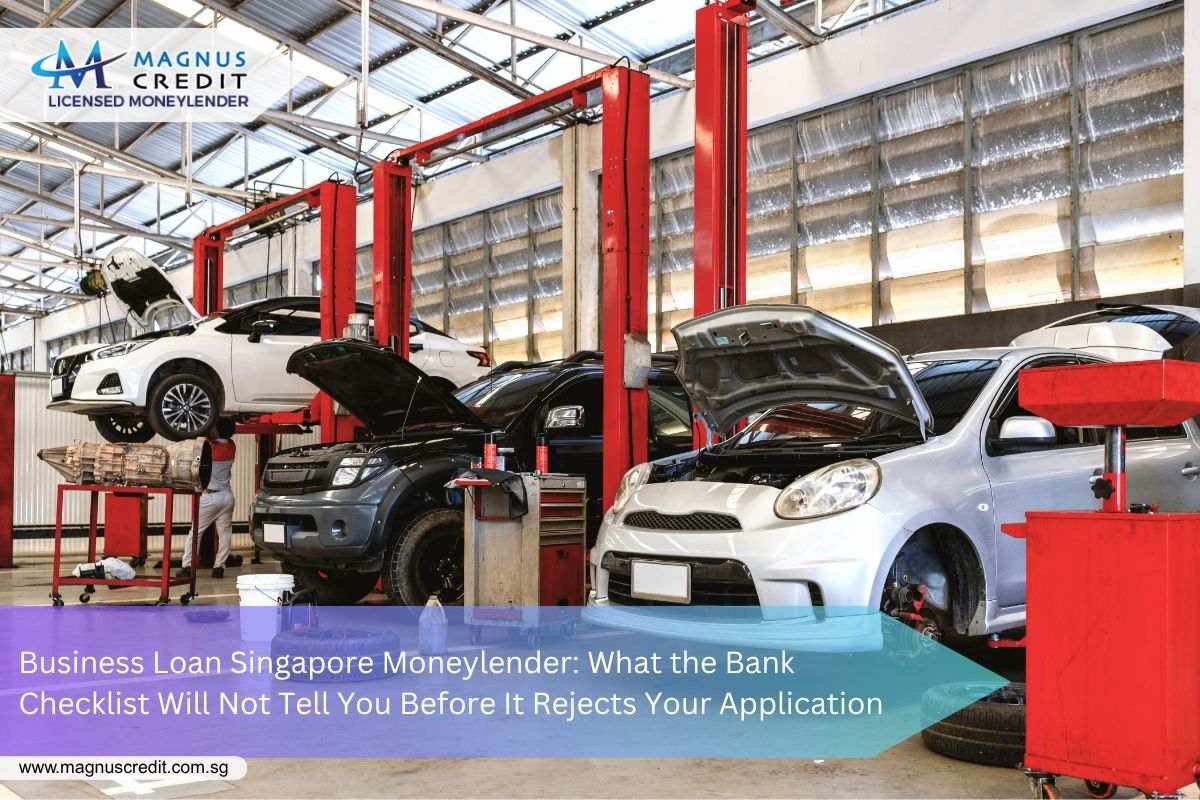
- Cash-heavy businesses such as Ubi automotive workshops often fail bank cross-referencing checks because P&L statements and bank deposit records do not match exactly. Licensed moneylenders assess each case individually.
- Magnus Credit has been licensed since 2009, is a Singapore Finance Association member, and is Credit Association of Singapore accredited.
- Magnus Credit maintains a 4% monthly interest cap and a 10% admin fee cap across all business loans. Total charges cannot exceed 100% of the original loan amount.
- On a S$40,000 business loan repaid over 12 months, the total interest is S$11,145 and the total cost including the admin fee is S$15,145.
The rejection letter arrived on a Thursday. Three words stood out: insufficient financial history.
Your workshop has been running for 14 months. Six lifts are in operation. Eight staff are on payroll. A confirmed fleet contract starts next month. 120 vehicles. Routine servicing. Last quarter, the business made S$280,000. The loan needed was S$40,000 for parts and equipment to service the contract.
The bank did not evaluate any of that. They looked for 2 to 3 years of audited accounts. They found 14 months. The application was rejected before a loan officer read the revenue figures.
This is not a story about a bad business. It is a story about a checklist built for a different kind of business.
Why Banks Reject SME Applications: The 7 Real Reasons
Understanding the rejection is the first step. Here are the verified reasons Singapore SMEs are turned away.
- Short Financial History
Banks require 2 to 3 years of audited profit and loss statements. A business in year one or two fails this check automatically. Current revenue does not override it. A business earning S$300,000 in its first 18 months still gets rejected on this criterion alone.
- Director’s Personal Credit History
Banks pull the personal credit record of every company director. A director who missed credit card payments three years ago, before the business existed, carries those defaults into the business loan assessment. Personal finances and business finances are not as separate as most directors assume.
- The Cash Flow Mismatch
Banks cross-reference your P&L statement against corporate bank statements. Cash-heavy businesses, including automotive workshops, food operators, and trades businesses, often receive partial cash payments that are not deposited into the corporate account on the same day they are received. The P&L shows higher revenue than the bank statement reflects at any given point. The bank flags this as a discrepancy. The business is operating correctly. The bank’s system cannot read it.
- Vague Loan Purpose
“Working capital” is the most common reason listed on SME applications. It is also the most commonly rejected. Banks want a specific use case with documentation. A named piece of equipment with a supplier quotation. A confirmed purchase order being financed. A workshop needing S$30,000 to stock parts for a new contract cannot produce that level of documentation quickly. The application fails before the revenue is reviewed.
- No Collateral
Most banks require a personal guarantee backed by real estate or other assets. A first-generation business owner who does not own property cannot clear this gate. Strong revenue and solid customer contracts do not substitute for collateral in a bank’s risk model.
- High Existing Debt
Banks calculate your Debt Service Coverage Ratio. They look at all debt held by the business and its directors. An owner with a personal car loan and an HDB mortgage may have used up most of their available debt capacity before the business loan application is even assessed.
- Industry Risk Classification
Banks maintain internal risk classifications for industries. These classifications are not published. Automotive, food and beverage, and early-stage service businesses appear frequently in higher-risk categories. The rejection comes back as “does not meet lending criteria” without specifying which criterion failed.
What a Licensed Moneylender Assesses Instead
A licensed moneylender assesses each application individually. This is a requirement under the Moneylenders Act. It is not a marketing claim.
The assessment starts from what exists right now. Current revenue. Bank statements showing incoming cash flow over the past 3 to 6 months. The ACRA business profile. The director’s background and income from the most recent Notice of Assessment. The current loan position via the MLCB credit check.
A Ubi workshop making S$280,000 last quarter has that revenue recorded in its bank statements. The evidence exists even if the formal audited P&L history is only 14 months old. A confirmed fleet contract is a relevant context. None of this requires 3 years of accounts to assess.
This is not automatic approval. Each case is assessed on repayment capacity and existing obligations. What it means is that the rejection does not happen before the numbers are read.
The Ubi Reality: Why Location Matters for This Audience
Magnus Credit is at 301 Ubi Ave 1. The Ubi industrial corridor is home to automotive workshops, logistics operators, fleet managers, and SME business owners. This is the neighbourhood.
Ubi businesses have a specific financing problem. Automotive workshops are cash-heavy and revenue-cyclical. Service volumes peak before Chinese New Year and school holidays. They drop mid-quarter. Large fleet accounts pay on 30-day terms. Staff payroll and parts suppliers require payment within 14 days.
That timing gap is a predictable working capital problem. It is not evidence of a failing business. A bank requiring 2 years of audited accounts cannot solve it. A licensed moneylender that reads 6 months of bank statements and understands Ubi business cycles can.
Magnus Credit has been operating at this address since 2009. The Ubi business community is not an acquisition target. It is the neighbourhood.
What Documents You Actually Need
For a sole proprietor or partnership:
Your NRIC. Your most recent IRAS Notice of Assessment. Your last 3 to 6 months of personal bank statements showing business income. Your ACRA business registration.
For a Private Limited company:
Your ACRA business profile from Bizfile. Your last 3 to 6 months of corporate bank statements. Each director’s NRIC and personal Notice of Assessment. Your most recent P&L if available. If not yet prepared, the bank statements carry the assessment weight.
You do not need 2 years of audited accounts. You do not need property assets. You do not need a guarantor who owns property, though providing one may affect the assessed loan amount.
Apply via Singpass MyInfo at solution.eform.sg/magnuscreditsg/myinfo before visiting the office. The application takes 2 minutes. You get an in-principle response before you take time out of a working day to come in.
In-person verification at the office is required before funds are released. This is a MinLaw regulation for every licensed moneylender. Anyone offering to skip this step is not operating within the licensed framework.
The Exact Cost Structure: One Legal Clarification Included
For sole proprietors and individual business borrowers:
The Moneylenders Act caps interest at 4% per month on the reducing balance. Admin fees are capped at 10% of the principal. Total charges cannot exceed 100% of the original loan amount. Borrowing limits are based on individual income tiers: up to 6 times monthly income for annual income above S$20,000.
For Private Limited companies:
The Moneylenders Act’s income-based borrowing limits apply to individual borrowers, not to corporate entities. For a Pte Ltd company, there is no prescribed 6x monthly income formula. The loan amount is assessed against the company’s demonstrated revenue and the directors’ financial background.
Magnus Credit maintains the 4% monthly interest cap and the total charges cap across all business loans including Pte Ltd borrowers. This is policy. Borrowing limits for Pte Ltd companies are discussed individually based on actual company numbers.
The exact math on a S$40,000 loan repaid over 12 months:
The monthly repayment is S$4,262. This stays the same each month. The interest portion starts high and falls as the principal reduces.
- Admin fee (10%): S$4,000 upfront. You receive S$36,000 in hand on day one.
- Month 1 interest: S$1,600
- Month 6 interest: S$1,023
- Month 12 interest: S$164
- Total interest across 12 months: S$11,145
- Total cost including admin fee: S$15,145
Late fee if a payment is missed: maximum S$60 per month. Late interest is 4% on the overdue repayment amount only.
Total cap: all charges cannot exceed the original loan principal. The debt has a ceiling.
Magnus Credit Licence 13/2026 is verifiable on the MinLaw Registry at rom.mlaw.gov.sg. Every contract is explained line by line before signing. Nothing appears in the contract that was not discussed before the pen was picked up.
Frequently Asked Questions
Can a newly registered Singapore business get a loan from a licensed moneylender?
Yes, subject to individual assessment. Unlike banks that require 2 to 3 years of audited financial history, licensed moneylenders assess current revenue and recent bank statements. A business with 6 to 12 months of consistent incoming cash flow has a viable application. Each case is assessed individually under the Moneylenders Act.
How much can an SME borrow from a licensed moneylender?
For sole proprietors earning above S$20,000 annually, the limit is up to six times monthly income across all licensed moneylenders. For Private Limited companies, there is no prescribed formula. The loan amount is discussed based on company revenue and repayment capacity. Speak to Magnus Credit directly with your bank statements to get an accurate picture.
How fast is approval compared to a bank?
Bank SME loan approval takes 2 to 4 weeks. A licensed moneylender can assess and respond within 1 to 3 working days for applicants with complete documents. Applying via Singpass MyInfo online gives an in-principle response before the office visit. Same-day disbursement is possible for eligible applicants who complete in-person verification during office hours.
Will this loan affect my CBS credit score or future bank eligibility?
No. Licensed moneylenders report to the MLCB. Banks use the CBS. These are legally separate systems. A Magnus Credit loan does not appear on your CBS record.
One nuance: when you apply for bank financing in future, the bank reviews your bank statements. Regular outgoing payments to a licensed moneylender appear in that history. This is bank statement analysis, not MLCB cross-referencing. A consistent on-time repayment record demonstrates you manage debt responsibly and is a positive signal for any future bank assessment.
Does a bank rejection affect my chances with a licensed moneylender?
No. A bank rejection does not appear on your MLCB record. Licensed moneylenders conduct their own independent assessments. The bank rejection itself is not a factor.
Apply Before the Contract Window Closes
The fleet contract starts next month. Waiting 4 weeks for a bank decision is not a business timeline.
Apply via Singpass MyInfo at solution.eform.sg/magnuscreditsg/myinfo. It takes 2 minutes. If your numbers do not work for the loan you need, the team will tell you before you make the trip.
Magnus Credit is at 301 Ubi Ave 1, #01-279. Three minutes from Ubi MRT Exit A.
Call +65 6338 9891. Mon-Fri 11am-7pm. Sat 11am-6pm.