For most people paying tuition, a purpose-built education loan beats a personal loan because of lower, delayed interest and repayment terms built around studying rather than earning.
A personal loan still earns its place as a fast bridge or top-up, for example when living costs, equipment or a timing gap sit outside what an education loan covers. Before deciding, check the Higher Education Student Loan (HESL) and the CPF Education Loan Scheme, since both are the first ports of call for tuition itself.
Education loan vs personal loan at a glance
The two routes are built for different jobs, and that shows up the moment you compare how each one treats interest, timing and purpose.
- End use: education loans are tied to tuition and approved course costs; personal loans can be spent on anything, from a laptop to rent.
- Interest timing: the former Tuition Fee Loan was interest-free while studying, while the CPF Education Loan Scheme begins charging interest from the point funds are deducted from your Ordinary Account.
- Repayment tenure: education loans typically allow repayment to stretch well beyond graduation; personal loans usually run on shorter, fixed terms agreed at disbursement.
- Moratorium: education loans commonly defer repayment until after your course ends; personal loans rarely offer this.
- Loan quantum: government-linked schemes can cover a substantial share of subsidised tuition, while personal loan limits depend on your income and the lender’s own policy.
- Documentation and speed: education loans need an offer letter and fee schedule, which takes institutional processing time; personal loans, especially through Singpass Myinfo, can move faster.
If you are funding a full degree, start with HESL or the CPF Education Loan Scheme. If you need to cover a partial shortfall, equipment or an urgent gap, a personal loan is the more practical tool.
Core differences: interest, tenure, moratorium and eligibility
The headline rate on either loan tells you very little on its own. What actually decides the total cost is when interest starts, how long you take to repay, and whether you get a break from repayments while studying.
Interest. The Tuition Fee Loan, now being replaced by the Higher Education Student Loan from 1 July 2026, charged no interest during the study period itself. The CPF Education Loan Scheme works differently: interest on the amount withdrawn accrues from the point the deduction is made from your CPF Ordinary Account, commonly at 2.5% per annum, with repayments to that account beginning roughly a year after graduation.
Personal loans charge interest from day one, with the rate set by the lender’s own risk assessment rather than a government formula. When comparing offers, look past the headline rate and work out the effective annual cost once fees are added, since two loans with similar advertised rates can land very differently once interest timing is factored in.
Repayment tenure. A longer tenure lowers your monthly instalment but increases the total interest paid over the life of the loan, a trade-off that applies to education loans and personal loans alike. Education loans tend to allow longer overall repayment windows because they are designed around a graduate’s future income, not a borrower’s income at the point of signing.
Moratorium. A moratorium is simply a deferral: you borrow now but do not have to start repaying until a set point later, usually after you finish studying. Government-linked education financing commonly builds this in, which matters enormously if your only income during your course is a part-time job or an allowance. Personal loans almost never include a moratorium: repayment usually starts the month after disbursement.
Loan quantum and end use. Government-linked education financing such as HESL and its predecessor, the Tuition Fee Loan, can cover up to 90% of subsidised tuition for university students. Personal loans carry no fixed tuition cap; your limit depends on your income, existing debt and the lender’s own policy, which also means they can cover costs that an education loan is not meant to touch, such as a laptop, accommodation deposit or exam resit fee.
- Education loans require an acceptance letter and a tuition fee schedule from your institution before disbursement.
- CPF Education Loan eligibility runs through your own or your family’s CPF balances, not a credit check.
- Personal loans from a bank or licensed money lender in Singapore require income proof and identity verification, often streamlined through Singpass Myinfo.
Regulatory context. MAS notices on excluded unsecured credit facilities set out conditions affecting how banks structure certain education-related lending, which is one reason bank education loan products can differ noticeably from a standard personal loan in how they are underwritten.
One figure worth sitting with: a Tuition Fee Loan or HESL can cover up to 90% of subsidised university tuition, which is why most students should treat the education loan route as the default and reserve a personal loan for whatever that 90% does not stretch to.
How to decide which loan fits your situation
Working through a short checklist beats comparing two interest rates in isolation, because the real cost depends on timing as much as on the number itself.
- Confirm what the money is for: tuition and approved course fees point towards an education loan, while living costs, a laptop or an urgent bill point towards a personal loan.
- Check when interest starts to accrue on each option and whether a moratorium applies while you are studying.
- Work out the total repayment cost, not just the monthly instalment, across a realistic tenure for each option.
- Confirm application cut-offs and transition dates, particularly around the move from the Tuition Fee Loan to HESL, and compare how quickly each route can actually disburse funds.
- If you are still unsure, prepare the paperwork for both routes in parallel and commit to whichever one offers the lower total cost within a timeline that works for you.
Pro Tip: Run the numbers for at least two repayment tenures before you sign anything: a 2 percentage point difference in effective interest rate can shift the cheaper option once the term stretches past five years.
How to apply for each type of loan
Each route has its own paperwork, channel and timing, and missing a cut-off date can cost you the better deal entirely.
- HESL / Tuition Fee Loan: the Tuition Fee Loan is being replaced by the Higher Education Student Loan from 1 July 2026, so check your institution’s own cut-off date rather than assuming the old scheme’s deadlines still apply, and apply through your institution’s financial aid office.
- CPF Education Loan Scheme: funds are drawn from CPF Ordinary Account savings, interest accrues from the point of each deduction, and repayment to the Ordinary Account typically begins around a year after graduation.
- Bank education loans: expect to submit an offer letter, a tuition fee schedule and income documents for a guarantor if one is required; approval timelines generally run alongside the institution’s own billing cycle.
- Personal loans: typical requirements are identity documents, income proof and, where available, Singpass Myinfo for faster verification; licensed moneylenders often move faster than banks on both approval and disbursement.
- Using a personal loan as a bridge: this works best when your education loan application is already submitted but not yet disbursed, and you need to cover a fee deadline in the meantime, ideally with a plan to repay the bridge quickly once the larger loan comes through.
A licensed lender’s perspective on the personal loan route
Borrowers who choose the personal loan route still deserve the same transparency that an education loan applicant gets from a government scheme. We structure our personal loan with a clear fee breakdown and no hidden charges, and our online application runs through Singpass Myinfo so verification does not become its own bottleneck.
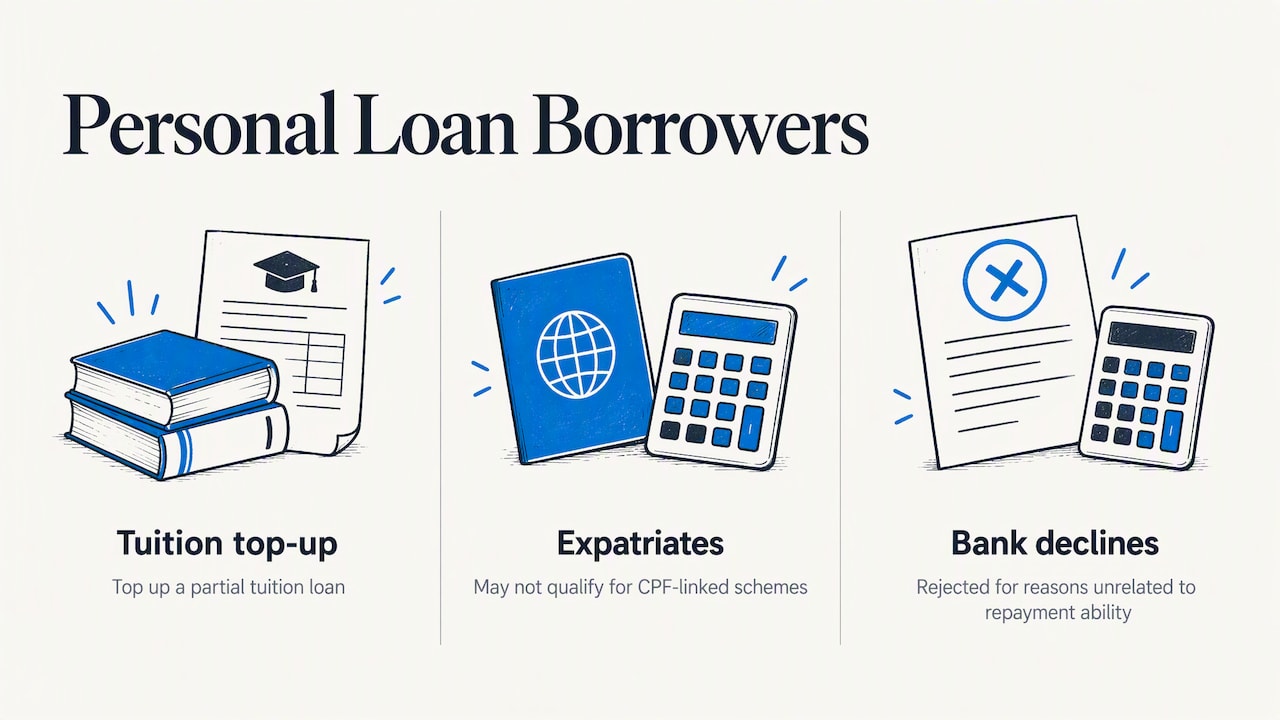
We see this route used most often by people topping up a partial tuition loan, expatriates who do not qualify for CPF-linked schemes, and borrowers previously turned down by a bank for reasons unrelated to their ability to repay.
Preparing identity documents and recent income proof in advance is the single biggest factor in a faster decision, and our repayment plans are built around what a given borrower can realistically manage rather than a single fixed template.
Borrow for your future self, not just this semester
The cheapest loan on paper is not always the right one if it leaves you repaying faster than your income can comfortably support once you graduate. Where an education loan with a moratorium is available, it usually makes more sense to preserve CPF balances and personal savings for later rather than draw them down early.
A personal loan has its place, but it should be sized to the actual gap, not the easiest number to borrow. Look at total repayment cost across the full term, not the headline interest rate alone: that single habit prevents most of the expensive borrowing decisions people later regret.
A fast, transparent personal loan option when you need one
When tuition is covered but a gap remains, a licensed personal loan can close it without the paperwork delays that often come with institutional financing. We process applications online through Singpass Myinfo, state every fee upfront, and build repayment plans around what you can realistically manage rather than a fixed template.
- No hidden charges: every fee is disclosed before you sign.
- Fast online application, with decisions often available the same day documents are verified.
- Repayment options tailored to your income, not a one-size schedule.
Check your eligibility and apply for a personal loan today.
Frequently Asked Questions
Is an education loan always cheaper than a personal loan?
Not always: the cheaper option depends on when interest starts to accrue and how long you take to repay, not just the headline rate. Official worked comparisons between the Tuition Fee Loan and the CPF Education Loan Scheme show that one can become more expensive than the other depending on your repayment horizon, so run the numbers for your own timeline before assuming.
What is the difference between HESL and the CPF Education Loan Scheme?
HESL replaces the Tuition Fee Loan from 1 July 2026 and was interest-free during study under its predecessor scheme, while the CPF Education Loan Scheme draws on your or your family’s CPF Ordinary Account and starts charging interest from the point each deduction is made. They can be used together or separately depending on your eligibility and how much of your tuition each one covers.
Can I use a personal loan to pay for tuition instead of an education loan?
You can, but it is rarely the cheaper choice because personal loans charge interest from day one and do not usually include a moratorium during study. A personal loan tends to work better as a bridge or top-up for costs an education loan does not cover, such as living expenses or equipment.
Does taking an education loan or personal loan affect my credit score?
Both loan types are typically reported to credit bureaus and missed repayments on either can affect your score. Government-linked education loans are generally assessed on eligibility rather than a full credit check at application, while personal loans from banks or licensed moneylenders usually involve a credit assessment upfront.
When should I use a personal loan as a bridge while waiting for an education loan?
A personal loan bridge makes sense when your education loan application is already submitted but has not yet disbursed, and you are facing a fee deadline in the meantime. Keep the bridge short and plan to repay it as soon as the education loan funds arrive, since prolonging a bridge loan adds unnecessary interest cost.