When managing business finances, choosing the right funding option is crucial to maintaining healthy cash flow and supporting growth. Two common choices are a line of credit and a business loan, each suited to different financial needs and situations. Understanding their differences can help you decide which option aligns best with your cash flow patterns and business goals. The comparison below will guide you in determining whether a line of credit or a business loan is more appropriate for your specific circumstances.
Business loan vs line of credit: a head-to-head comparison
A business loan, often called a term loan, hands you a lump sum upfront that you repay on a fixed schedule, usually with equal instalments over a set number of months or years.
A line of credit works differently: it is a revolving facility that lets you draw funds as needed, repay them, and draw again, up to an agreed limit. You generally pay interest on what you have actually drawn, rather than on the full facility, as explained in this business loan vs line of credit comparison.
The practical difference shows up fastest in how “available but unused” works. With a loan, you receive everything at once and start repaying according to the agreed schedule, whether or not you have spent it all.
With a line of credit, an unused limit may cost you little or nothing beyond possible commitment or maintenance fees, which makes it a natural fit for needs that fluctuate month to month.
Typical use cases map cleanly onto this structure:
- Payroll and short-term cash flow gaps: A line of credit lets you draw only what a slow month requires, then repay when invoices clear.
- Seasonal stock purchases: Retailers and wholesalers draw before a peak season and repay once sales come in.
- Equipment purchases: A defined cost with a known price point suits a term loan, since you need the full amount on day one.
- Expansion or renovation: A one-off project with a fixed budget suits a lump-sum loan repaid over a matching timeline.
Eligibility and provider types also diverge. Banks typically offer both products but may favour established businesses with several years of financial history.
A licensed money lender may offer a faster application process and consider applicants with different financial circumstances, which matters if your business has thinner financials or you have been turned down by a bank. Approval still depends on the lender’s assessment.
Government-backed financing schemes also sit alongside these channels. For example, Enterprise Singapore’s Enterprise Financing Scheme supports eligible businesses through participating financial institutions, with Enterprise Singapore sharing part of the lending risk.
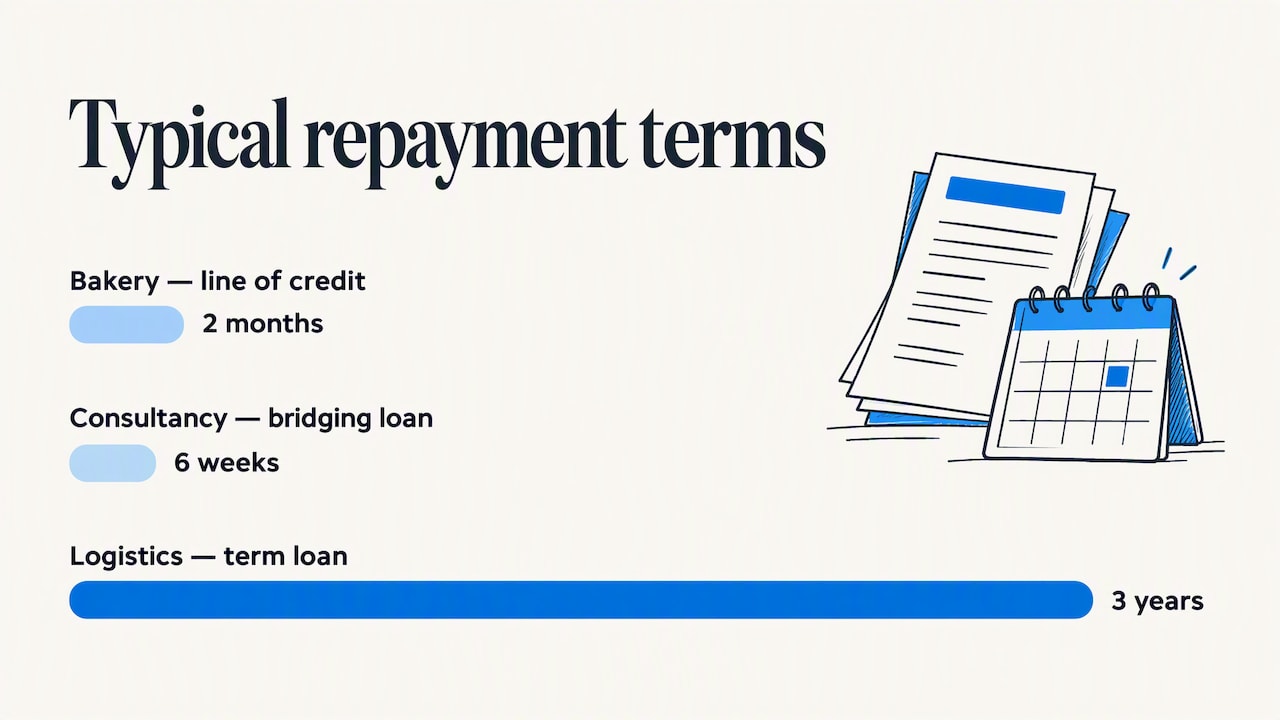
Three short scenarios illustrate how this plays out:
- A bakery with a predictable but seasonal cash cycle draws S$15,000 from a line of credit ahead of a festive period, repays it over two months once sales pick up, and avoids further borrowing interest during periods when the balance is fully repaid.
- A logistics firm needs S$80,000 to buy a delivery van outright and takes a term loan with fixed monthly repayments over three years, matching the financing period to the asset’s expected use.
- A consultancy facing a one-off gap between finishing a project and receiving payment uses a business bridging loan to cover payroll for six weeks, then clears the balance once the client pays.
Each scenario turns on the same question: is the need recurring and uncertain, or singular and known in advance? That distinction often helps determine which financing option fits better than a feature comparison alone.
A Decision Framework to Match Financing to Your Cash Flow
Before you apply for anything, answer five questions honestly. They can help you decide which financing option suits your needs more reliably than interest rates alone.
- How much do you need? A precise, one-time figure points to a loan; a range that shifts month to month points to a line of credit.
- How often will you need it? Once points to a loan. Repeatedly, even unpredictably, points to a line of credit.
- How predictable is the timing? If you can forecast exactly when you will need funds, a loan’s fixed repayment schedule may work well. If timing depends on client payments or seasonal demand, flexibility matters more.
- Do you have collateral or a strong track record? Secured facilities, whether loans or lines of credit, may offer access to larger limits or more favourable terms, depending on the lender.
- What is your growth horizon? A short-term gap favours a line of credit or a bridging facility; a multi-year investment favours a term loan matched to the asset’s useful life.
Consider your answers together. If most point towards recurring, uncertain or short-term funding needs, a line of credit may be more suitable.
If most point towards fixed, one-off or multi-year expenses, a term loan may be the better option. A mixed result may mean your business could benefit from different facilities for different purposes.
Once you know the financing option, prepare the paperwork. Lenders typically want recent financial statements, business registration records, director or owner identification, and a cash flow projection covering the next six to twelve months.
Having these ready before you apply can help shorten the application process.
Pro Tip: Contact two or three lenders before applying and ask the same five questions:
- What is the total borrowing cost, including fees?
- How fast is disbursement?
- Is the facility secured or unsecured?
- What happens if I miss a repayment?
- Is there a minimum draw or balance requirement?
Comparing the answers across lenders helps you understand their terms and identify any differences that could affect your business.
If your situation involves a delayed client payment rather than a new project, a short-term bridging facility may suit you better than either a standard loan or a line of credit.
It is worth understanding how bridging finance works for SMEs before committing to a longer-term product.
How to Compare the True Cost of a Loan Versus a Line of Credit
Headline interest rates can be misleading when viewed in isolation.
A business loan requires repayment of the disbursed principal according to its agreed schedule, with interest calculated using the method specified in the contract. A line of credit generally charges interest only on the amount drawn.
This can make a line of credit cheaper in certain situations, even when its quoted interest rate is higher.
Fees complicate the comparison further:
- Arrangement or processing fees: Charged upfront on some loans and credit facilities when first opened.
- Commitment fees: May be charged on the unused portion of a line of credit to compensate the lender for keeping funds available.
- Renewal fees: May apply when a line of credit is reviewed and extended.
- Early repayment fees: Some loans impose charges if you clear the balance ahead of schedule.
A Practical Example of Borrowing Costs
A worked example makes this concrete. Say you need access to S$50,000 but will not require the entire amount immediately.
As a term loan repaid over 12 months, you receive the full S$50,000 upfront and begin making repayments according to the agreed schedule, regardless of whether you use all the funds immediately.
With a line of credit, you could draw only the amount required at each stage. If your business needs S$20,000 initially, interest would generally apply only to that amount until further withdrawals are made.
Suppose you eventually draw the full S$50,000 for six months before repaying it. The interest cost would depend on the applicable rate, outstanding balance and duration of each withdrawal.
The line of credit may cost less if you borrow smaller amounts for shorter periods. However, commitment fees, renewal charges or a higher interest rate could reduce those savings.
The true comparison point is the total borrowing cost, including every applicable fee, rather than the headline interest rate alone.
Where available, comparing the effective interest rate or annual percentage rate can also help you understand the borrowing cost, provided you use comparable loan amounts and repayment periods.
For businesses considering financing from a licensed money lender in Singapore, the Registry of Moneylenders’ borrowing guidelines explain the applicable interest limits, permitted charges and important borrower responsibilities.
Understanding these terms is particularly important when comparing different lenders and repayment arrangements.
Before accepting any offer, request a breakdown of:
- Total principal borrowed
- Interest calculation method
- Total interest payable
- Processing and other applicable fees
- Monthly repayment amount
- Total amount repayable
- Charges for late or early repayment
These figures give you a clearer picture of how the financing will affect your business’s cash flow.
What Actually Matters When You Choose Between the Two
The rule of thumb is simple: a line of credit suits ongoing, variable working capital, while a term loan suits a single, defined cost with a clear start and end.
Many business owners focus heavily on interest rates while overlooking the repayment structure, which can determine whether the facility helps or strains their cash flow.
If you are short on time, do three things before applying:
- Pull together your ACRA extract, recent financial statements and a rough cash flow projection.
- Run the five-question checklist above against your actual business situation.
- Contact a few lenders and compare their borrowing costs, repayment terms and eligibility requirements.
The goal is to choose financing that supports your business without creating repayment obligations that become difficult to manage.
Get a Business Loan Decision Without the Wait
At Magnus Credit, we understand that most small business owners do not have weeks to spare chasing paperwork. We have built our business loan application around speed and clarity, with Singpass Myinfo helping applicants submit their verified details digitally before completing the required verification and loan agreement procedures.
Our business financing offers several practical advantages:
- 0% processing fee: We disclose our fees upfront, including a stated 0% processing fee on our business loan.
- Flexible loan periods: Repayment terms are assessed according to your financing needs and circumstances.
- Convenient application: Apply online using Singpass Myinfo to simplify the initial application process.
- Practical business financing: Funding options for common small-business needs, including cash flow gaps and capital purchases.
These are the same practical considerations covered throughout this comparison: speed, transparency and a repayment structure that matches how your revenue arrives.
If a defined, one-off cost is what you are financing, explore Magnus Credit’s business loan options to learn more about the available terms and application process.
All applications remain subject to eligibility assessment and approval.
Frequently Asked Questions
1. Is a Business Line of Credit Better Than a Loan?
Neither is universally better. A line of credit suits recurring, variable working-capital needs, while a term loan suits a single, defined cost.
The right choice depends on how predictable your funding needs are, how long you expect to use the money and whether your business can comfortably meet the repayment obligations.
2. What Are the Downsides of Having a Business Line of Credit?
Lines of credit can carry commitment or renewal fees, which may add costs even when you draw little of the facility.
They also require more active management than a loan’s fixed repayment schedule. Depending on the agreement, interest rates may fluctuate, and the lender may review, reduce or adjust your available credit limit over time.
3. Can I Use a Personal Loan for Business Expenses Instead?
A personal loan can sometimes cover smaller business costs, depending on the lender’s permitted use of funds. However, it is generally better suited to personal rather than commercial financing needs.
Using a personal loan for business expenses also creates a personal repayment obligation. Before proceeding, compare the borrowing costs, repayment terms and implications for your personal finances.